Guide · Running in Seoul
Running in Seoul, a runner's guide to the city.
Where to run, when to go, what the seasons actually do, and what to know before you head out. Written from ten years of running here, not from a tourism brochure.
The short version
If you only read one section.
- The Han River path is the spine. About 41 km of paved, lit, mostly car-free trail along both banks. If you only have one run in Seoul, that is where you do it.
- For hills, you have Namsan and Bukhansan. Namsan is a 3 km loop in the city centre. Bukhansan is a real mountain an hour out by subway.
- For shorter park loops, Olympic Park (Jamsil), Yeouido Park (in the river), Seoul Forest (Seongsu), World Cup Park (Sangam).
- Best running months: April–June and mid-September to late October. Summer is humid; winter is cold but very runnable.
- Run early. Before 7 a.m. you get a quieter river path, cooler air in summer, and the city moving into the day.
- Check the air on bad days. PM2.5 spikes happen most in spring. Most days are fine.
The rest of this page is the longer version of those six lines , what each one actually looks like once you are out there.
Where to run
The Han River, plus the parks and one real mountain.
The Han River, the spine
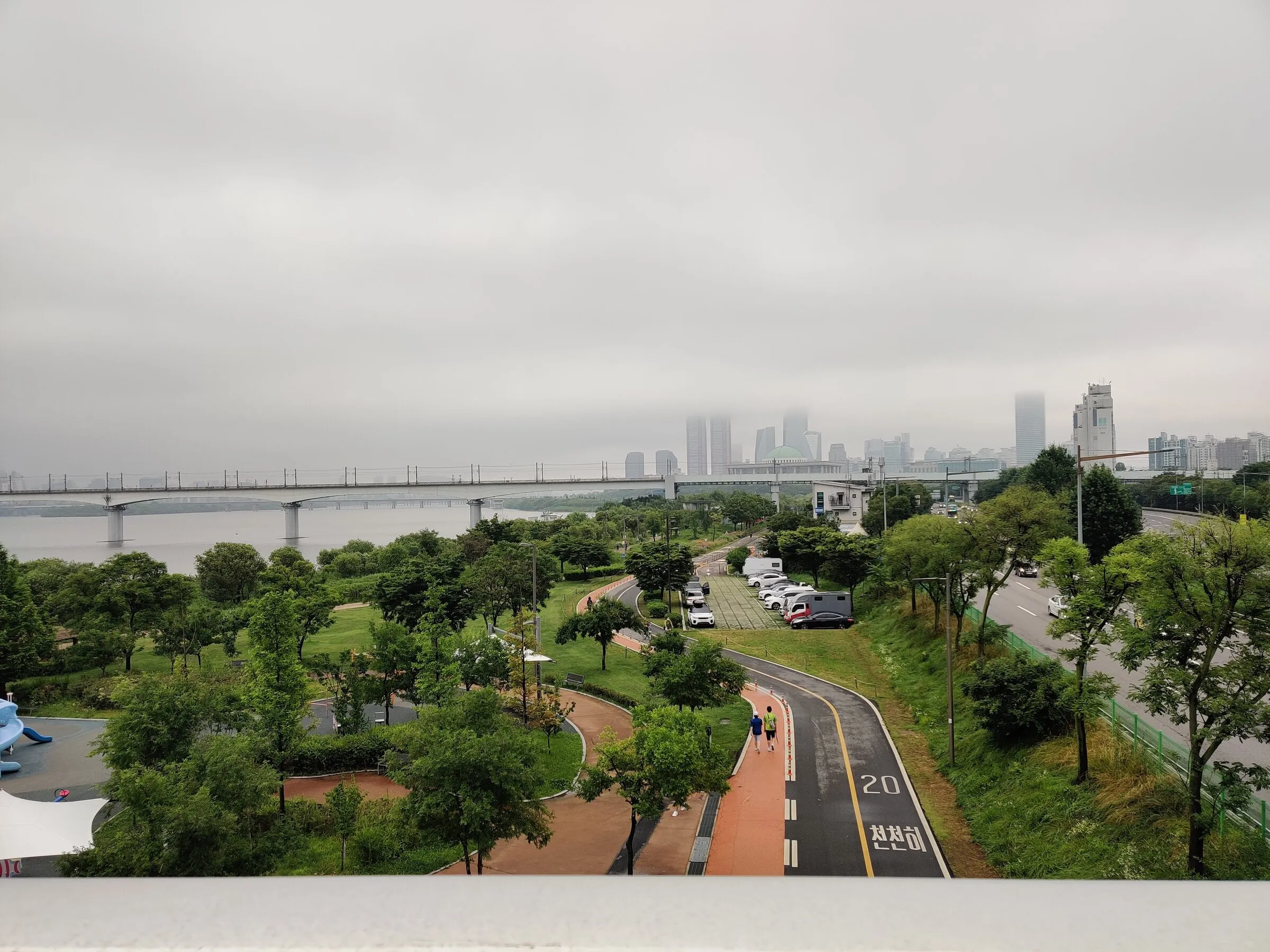
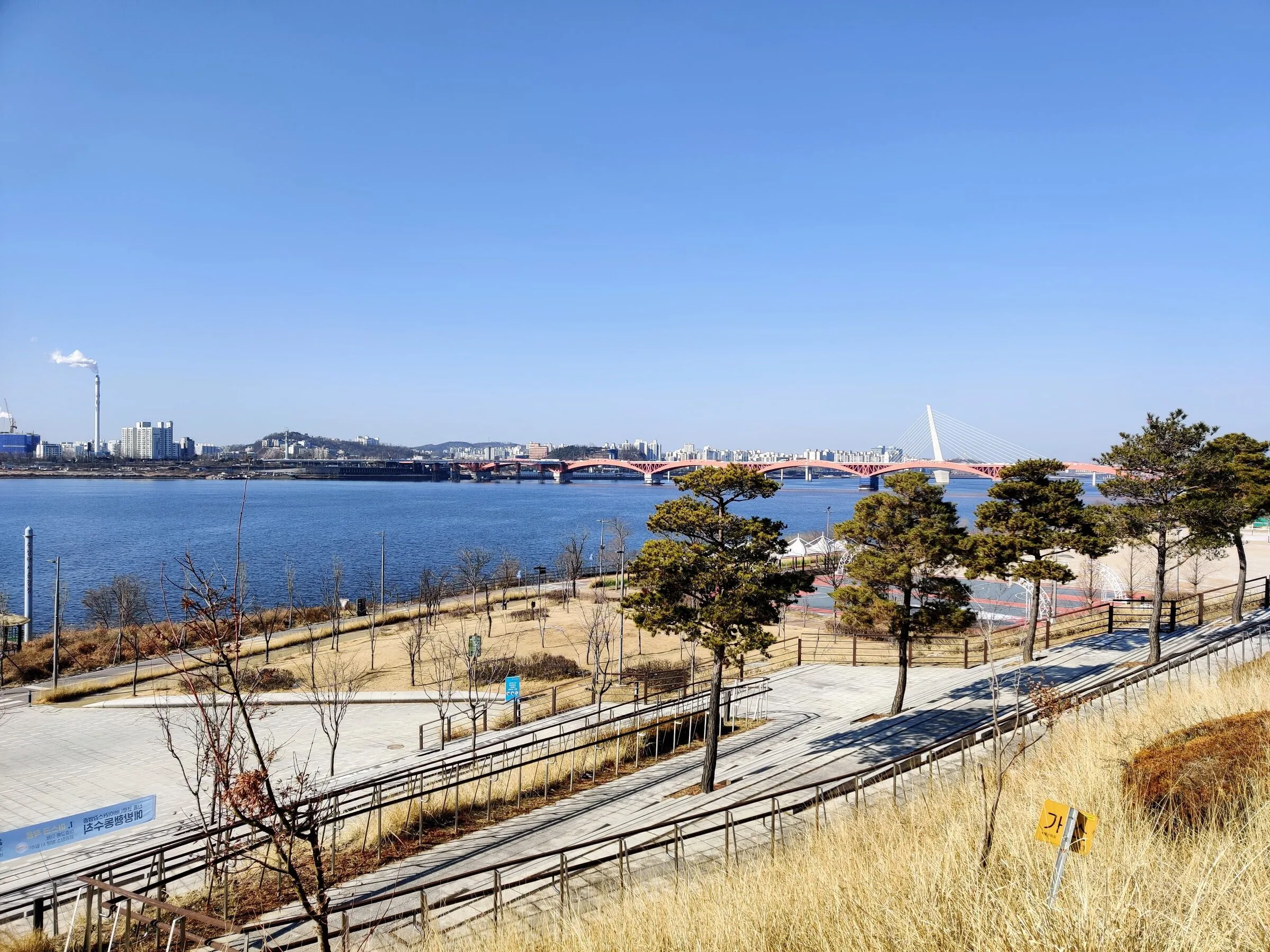
Almost everything written about running in Seoul comes back to the Han. There is a reason: the path runs the length of the city on both banks, it is paved, lit, well-signed, and almost entirely free of cars. Water fountains and clean public toilets show up every kilometre or two. Convenience stores sit at every park entrance. You can run as far as you want and turn around when you feel like it.
The whole north–south sweep from Gimpo in the west to Hanam in the east is somewhere around 41 km, but you do not run it that way. Most people pick a stretch between two bridges and loop back. The most used bases are Mapo (north bank, the most-used runners' neighbourhood, Mangwon Hangang Park, Mapo Hangang Park, easy to reach from Hongdae), Yeouido (the island in the middle of the river, with its own park loop and the Banpo Bridge fountain views), Ichon (south bank, central, near Itaewon and Yongsan), and Jamsil (east end, by Olympic Park and Lotte Tower).
The Han is not all the same. Mapo and Mangwon feel quieter and more residential; Yeouido is glassier and busier; Ichon has the prettiest sunsets; Jamsil has Lotte Tower hanging over your shoulder. If a guide tells you the Han is "vibrant" and leaves it there, find another guide.
Namsan, the everyday hill
Namsan is the small forested mountain in the middle of Seoul with N Seoul Tower on top. The runner's loop is the road that rings it, about 3 km, one continuous climb on the south side followed by a long downhill on the north. Closed to most traffic, paved, and lined with trees. You can do it in twenty minutes from Itaewon, Myeongdong, or Yongsan, get a real climb in, and be back for breakfast.
Bukhansan, the real mountain
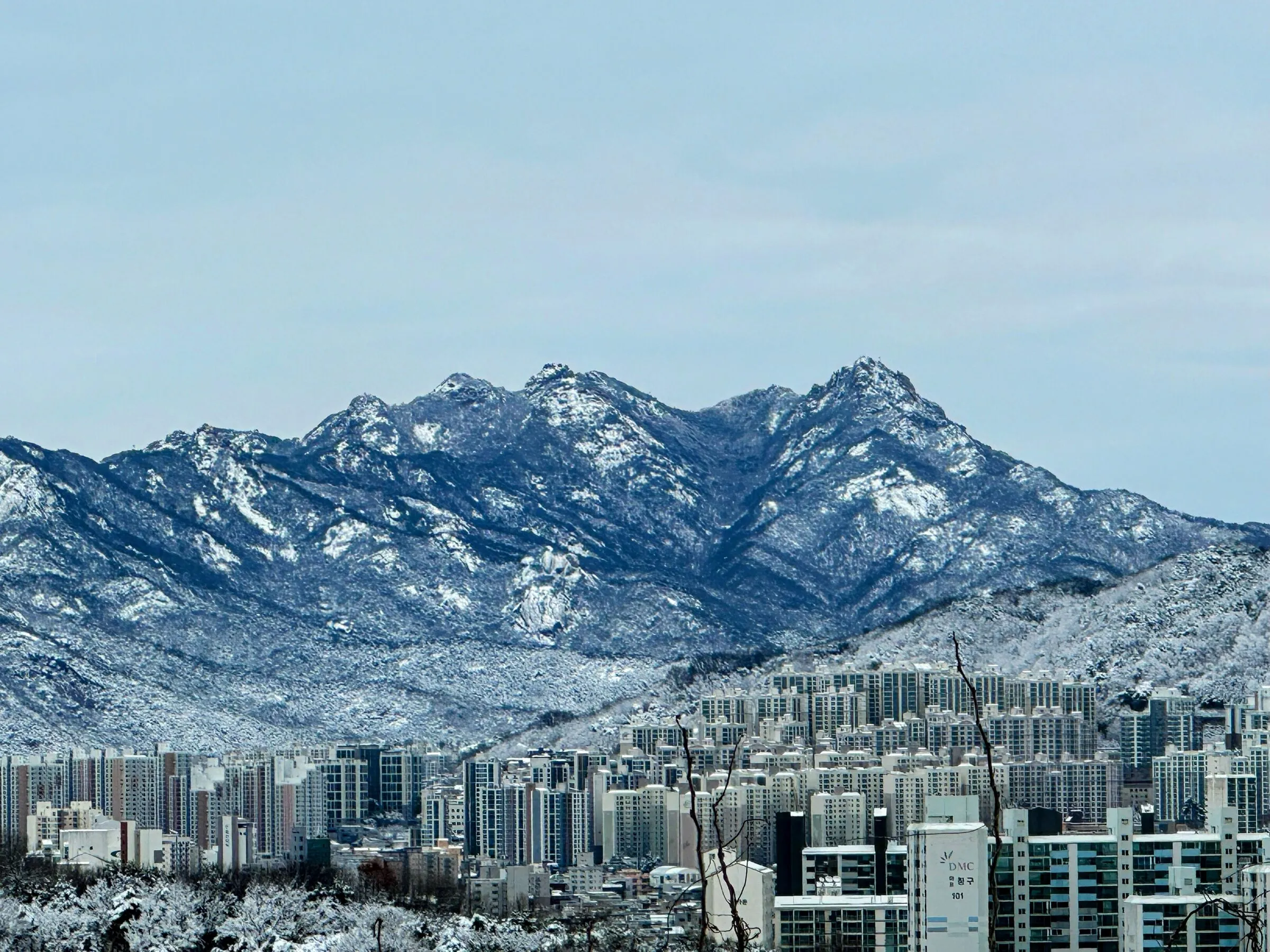
About an hour from the centre by subway, Bukhansan National Park is a granite mountain with marked trails up to Baegundae (836 m, the highest peak in the city limits) and a network of shorter loops below. The trails are rocky and steep in places; trail shoes help, road shoes survive. Most local runners I know treat Bukhansan as a weekend objective rather than a weekday run.
The park loops
When you want a short, predictable loop and do not want to deal with bridges or traffic lights, the parks are the answer.
- Olympic Park (Jamsil), the perimeter is about 5 km of soft surface and tarmac, with the 1988 venues and a few good hills on the east side.
- Yeouido Park, a flat 2.4 km loop in the middle of the office island, popular at lunchtime and after work.
- Seoul Forest (Seongsu), a 2 km loop with a deer enclosure in the middle and the river right next door.
- World Cup Park / Haneul Park (Sangam), built on a former landfill, more elevation than you expect, panoramic views of Seoul from the top of Haneul.
- Inwangsan / Ansan / Achasan, smaller hills with trails. Quieter than Namsan, no tower at the top.
When to run
Early, ideally, and the season matters more than the time.
Best time of day
Early. In summer, Seoul is over 30 °C and humid by nine in the morning, and the riverside is in full sun. In winter, the wind comes off the open water and the cold is sharpest mid-morning. The bike path is also a different animal before seven, quieter, slower, with the city moving into the day rather than already into it. Evenings work too, especially once the heat breaks; the river paths are well-lit and stay open all night.
Best season
April through early June, and mid-September to late October. Spring gives you cherry blossoms along the Han and through Yeouido Park (peak is usually the first week of April, but shifts a little each year), and the mornings stay cool. Autumn is the runner's season here, dry, cool, blue skies, and the air at its clearest. This is when most local races sit on the calendar, and it is the right time of year to plan a running trip if you have the choice.
Summer
Monsoon hits in late June and runs through July. The heat itself is not unusual for this part of Asia, but the humidity makes the heat index feel five to seven degrees worse than the thermometer reads. Run before seven or after sunset, drink before you are thirsty, and respect the air on bad days. If you must run mid-day in August, the open riverside is worse than a tree-shaded route through Namsan.
Winter
Seoul winters are cold and dry, typically -5 to -10 °C in January, occasionally lower for a few days. Both Han River paths are ploughed and remain runnable through almost the whole season. Ice tends to form on the footpaths off the main bike path and on the bridge approaches, not on the main path itself. A proper windproof shell matters more than thermal layers; the wind off the water is the variable to dress for.
Practical things to know
Air, safety, water, footing.
Air quality (fine dust)
The one thing that genuinely keeps Seoul runners indoors is fine dust (미세먼지). PM2.5 spikes are most common in spring, when transboundary dust drifts in from the west, and on still winter days when the city's own emissions stay put. Most days are fine. The two readings worth checking are PM2.5 and PM10, in either the AirVisual app or the government's 에어코리아 (Air Korea) site. Around 75 µg/m³ PM2.5, think about shortening the run or moving it indoors. Above 150, skip it.
Is it safe to run alone or at night?
Yes, in nearly every neighbourhood, at nearly any time. The Han River paths are well-lit, well-trafficked and patrolled. Korean women run alone on the river after dark routinely, and the most common point of conflict on the path is not safety but cyclists moving fast on the shared section. (Where it is separated, the bike path is on the river side and the running path is on the inside; stay on yours.)
The other thing to watch for is footing. Older sidewalks off the river have uneven tile and the occasional missing slab, and the wooden boardwalks on a few stretches get slick in rain. Headlamps are unnecessary on the main paths but useful on the Namsan loop after sunset.
Water, toilets, convenience stores
Public water fountains run roughly every kilometre along the Han River path, and the parks along the route (Mangwon, Mapo, Yeouido, Ichon, Banpo, Jamsil) all have clean public toilets and at least one convenience store. Water from the fountains is drinkable. Most fountains are turned off through winter and come back on around April.
Getting to and from the path
The fastest way to reach the river from most central neighbourhoods is on foot. From Hongdae or Mapo, you are about fifteen minutes to Mangwon Hangang Park. From Itaewon or Yongsan, about ten minutes to Ichon Hangang Park. From Gangnam, fifteen to twenty minutes to Banpo Hangang Park. If you would rather not run to the start, the subway is usually faster than a taxi at rush hour; look for stations with the suffix Hangang.
The wider scene
Crews, races and the rest of the running city.
Seoul has hundreds of running crews (러닝크루), most are neighbourhood-based, meet one to three evenings a week, and welcome drop-ins. A handful are explicitly English-friendly. See the running clubs and crews guide for the ones I would actually point a visitor toward.
The two big road races on the calendar are the Seoul Marathon (March, finishes at Olympic Stadium) and the JTBC Seoul Marathon (November). The Seoul International Half Marathon sits in March, and there are smaller events in the surrounding cities, Chuncheon, Gunsan, Incheon, every month of the year except deep winter. See the races and half marathon guide.
The Han River itself is also the busiest bike-rental, picnic and watersport park in the country. If you are travelling with people who do not run, the Han River activities guide covers what else the riverside is good for.
If you have arrived without shoes, the running shoes and gear guide covers where to buy what.
FAQ
Short answers, in case you skipped the rest.
-
Where can I run in Seoul?
The Han River path is the spine, about 41 km of mostly flat, paved, mostly car-free trail along both banks of the river, with lights and water fountains. For hills, Namsan Park gives you a 3 km loop with one real climb; Bukhansan National Park, about an hour from the centre by subway, is the proper mountain. For shorter park loops there are Olympic Park (Jamsil), Yeouido Park, and Seoul Forest (Seongsu).
-
Is it safe to run in Seoul, including alone and at night?
Yes, in nearly every neighbourhood, at nearly any time. The Han River paths are well-lit, well-trafficked and patrolled; CCTV is everywhere. Korean women run alone after dark on the river routinely. The two things to actually watch for are cyclists moving fast on the shared bike path (stay on the running side where it is separated) and uneven sidewalk tile in older neighbourhoods.
-
What is the best time of year to run in Seoul?
April to early June, and mid-September to late October. Spring gives you cherry blossoms along the Han River and cool mornings; autumn is dry, cool and blue-skied, and is the season most local runners train for. July and August are humid and hot. December to February are cold but very runnable.
-
Can you run in Seoul in winter?
Yes. Seoul winters are cold and dry, usually -5 to -10 °C in January, with occasional colder snaps, but the Han River paths are ploughed and runnable through almost the whole season. The wind off the open water is the thing to dress for; a proper windproof layer matters more than heavy thermal layers.
-
Does fine dust or air quality really affect running in Seoul?
Yes, on bad days. PM2.5 spikes happen most often in spring (transboundary dust) and on still winter days. Most days are fine. The two readings local runners actually check are PM2.5 and PM10 in the AirVisual app or 에어코리아 (Air Korea). Above 75 µg/m³ PM2.5, think about a shorter or indoor run; above 150, skip it.
-
Are there indoor running tracks or treadmills in Seoul?
Most mid-range and chain hotels have a treadmill in the gym. If yours does not, drop-in day passes at neighbourhood fitness centres run around 10,000–20,000 KRW. The 400 m university tracks at Yonsei and Korea University are open to the public outside of class hours; they are not formally booked, you just turn up.
-
Is there trail running in Seoul?
Yes. Namsan is the everyday trail, a 3 km loop with a runnable climb, ten minutes from the centre. Bukhansan is the real thing: granite peaks, proper switchbacks, an hour from Gangnam by subway. Inwangsan, Ansan and Achasan are quieter alternatives if you want a hill run without the Bukhansan crowds.
Run with me
If you would rather not figure it out alone.
I run these routes every week. A guided run is the fastest way to get the city right on the first morning, and you do not have to puzzle out which bridge to cross or which path is the bike side.